Automation has become a hot topic in pharmaceutical production, especially in capsule filling.
Yet many users feel uncertain when talking about automation:
- Does automation mean the machines are extremely complex?
- Do I have to go fully automatic?
- Will automation truly help daily production, or just increase costs?
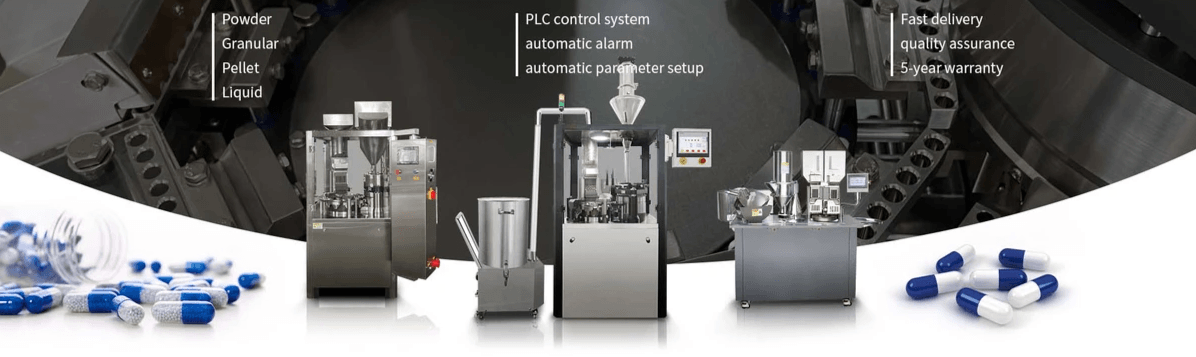
In reality, the automation options for capsule filling machines cover many aspects. These can include automatic material feeding, automatic filling, automatic inspection and rejection, and automated data monitoring. These features are not fixed—you can choose what fits your production needs, giving you better control over your operations.
What Does “Automation” in Capsule Filling Actually Mean?
Automation is more than just “the machine runs by itself.” It generally includes:
- Mechanical automation: The machine automatically performs core steps such as capsule separation, filling, and locking.
- Material supply automation: Powders or granules are fed automatically and consistently into the filler.
- Inspection and rejection automation: Empty or defective capsules are automatically detected and removed.
- Control and data automation: Operators can easily manage the machine via touchscreen and record production data.
Automation can be implemented step by step. Most pharmaceutical manufacturers upgrade gradually based on their own needs and budget.
Automation Options for Capsule Filling Machines
1. Basic Automation (Auxiliary Functions)
Even entry-level machines usually include features such as:
- Automatic capsule separation
- Automatic locking
- Assisted filling mechanisms
Main benefits:
Reduce operating difficulty, minimize human error, and make it easier for new operators to get started.
2. Semi-Automatic Fillers
A combination of human and machine operation, typically featuring:
- Core filling and locking processes are automated
- Capsule tray placement and removal may require manual work
- Control system is relatively simple
Suitable for:
Small-to-medium scale production, R&D or pilot lines, and manufacturers upgrading from manual equipment.
Main benefits:
A good balance between cost, flexibility, and efficiency.
3. Fully Automatic Fillers
These machines handle the entire process continuously, including:
- Automatic capsule loading and orientation
- Automatic filling and locking
- Automatic rejection of defective capsules
Important note: “Fully automatic” does not mean “no human involvement.” It means reduced dependence on operator skill, delivering more consistent products and predictable output over the long term.
Automation Around the Filling Process
Automation doesn’t stop at the filler itself. Upstream and downstream automation often brings the biggest improvements.
1. Automatic Material Supply Systems
Unstable feeding is a common pain point. Automated solutions include:
- Vacuum feeding machines
- Continuous feeding systems
- Closed transfer systems
Main benefits:
Maintain a stable flow of material, ensuring consistent fill weight and minimizing production interruptions.
2. Capsule Polishing and Inspection Automation
Filled capsules often require:
- Polishing and dust removal
- Metal detection
- Automatic rejection of defective capsules
Main benefits:
Improve product appearance and safety consistency, while reducing the manual workload of visual inspection.
3. Automated Capsule Transfer and Handling
Automatic conveyors and buffer hoppers connect:
- Filling machine
- Inspection equipment
- Packaging machines
Main benefits:
Reduce manual handling, lower contamination risk, and support continuous production.
Control and Data Automation
1. Smart Control Systems (PLC & Touchscreen)
Modern machines use these systems to:
- Clearly display machine status (running, alarms, etc.)
- Simplify operation (one-touch start/stop, parameter settings)
- Enable rapid response to faults
Key value:
A well-designed interface makes daily operation simpler, not more complicated.
2. Production Data Recording and Monitoring
Automation enables:
- Automatic batch data recording (output, runtime)
- Tracking key parameters
- Basic production analysis
Practical benefit:
Data automation becomes increasingly valuable over time, especially for process optimization and preparing compliance documentation. Having data readily available is a huge time saver.
Real Benefits of Automation in Daily Production
In real-world production, automation provides tangible benefits:
- Reduced reliance on skilled operators: Operations become more standardized
- More consistent product quality: Machines perform the same steps every time, reducing capsule fill variation
- Fewer human errors: Avoid mistakes caused by fatigue or oversight
- More predictable production planning: Output and runtime become easier to anticipate
How to Choose the Right Level of Automation
Decisions should be based on real production needs:
- Output and working hours: How much production per day? How many shifts?
- Product variety: Single product or frequent changeovers?
- Personnel: Operator skill level and staffing constraints
- Budget: Consider not only equipment cost but long-term operational costs
Often, a gradual automation plan is more practical and cost-effective than going straight to full automation.
Conclusion
Automation in capsule filling is a customized solution, not a one-size-fits-all standard. Experienced technical teams can design tailored automation to fit your production needs.
If you require guidance or a consultation, we are happy to provide support and share our experience with customized capsule filling automation.